How to Build a Daily Routine That Actually Sticks
Almost everyone has had a Sunday night where they decided to fix their whole life by Monday morning. A new alarm time, a new diet, a gym plan, a color-coded planner, maybe even a fresh notebook. It feels wonderful for about four days. Then a late night, a stressful meeting or a sick child arrives, one part of the plan slips, and by the second weekend the notebook is back in a drawer. If that pattern sounds familiar, the good news is that the problem is almost never your character. It is the way the routine was designed.
Most routines are written for an imaginary version of you: rested, motivated, with no surprises in the day. Real life has traffic, family needs, headaches and days when you simply have nothing left. A routine that lasts is one that still works on those days. It is smaller than you think it should be, it is attached to things you already do, and it gives you permission to be imperfect. Let us go through how to build one properly.
Why big routines collapse
When people change many things at once, they spend a lot of mental energy on decisions: what to eat, when to start, what to do first, whether today counts as a rest day. Decisions are tiring, and tired people fall back on old habits. A big routine also creates an all-or-nothing feeling. If you planned to wake at five, exercise, meditate, journal and study, and you only manage two of those things, it is easy to label the whole day a failure. That feeling is far more damaging than the missed tasks themselves, because it convinces you the system does not work for you, when in fact the system was simply too heavy.
Begin with one anchor
Habit researchers have long observed that new behaviors become automatic fastest when they are tied to something that already happens every day. You do not need to remember a new habit if it is triggered by an old one. Think about what is already stable in your day: waking up, making tea or coffee, sitting at your desk, finishing lunch, getting into bed. Choose just one of those moments and attach one small action to it. For example, after you pour your morning tea, you write down the three things that matter most today. That is the entire routine for the first couple of weeks. It will feel almost too easy, and that is exactly the point, because ease is what lets a habit survive a bad day.
Make the starting version very small
If you want to read more, commit to two pages. If you want to exercise, commit to five minutes of stretching or a short walk. If you want to learn a skill, commit to ten minutes. The purpose of the early weeks is not to see results, it is to prove to yourself that you are the kind of person who shows up. Once showing up feels normal, growing the habit is simple, and you will often do more than the minimum without forcing yourself. People who begin with an hour usually quit within a month. People who begin with five minutes quite often end up doing thirty, because starting was never the hard part again.
Build around your energy, not around someone else's schedule
You may have read that successful people wake up at five in the morning. Some do, and it suits them. Others do their best thinking at ten at night. Copying a stranger's schedule is a common reason routines fail, because it ignores your own body. For one week, simply notice when you feel sharp and when you feel foggy. Most people discover a clear pattern: a window of two or three hours where focus comes easily, and a dip later in the day. Put your most demanding work, such as writing, studying or solving difficult problems, in the sharp window. Leave email, errands and admin for the dip. Doing this alone can make a normal day feel noticeably lighter without adding a single extra hour.
Shape your surroundings so the good choice is the easy one
We like to believe that discipline is what separates people who keep habits from those who do not, but your environment does much of the work. If you want to walk in the morning, leave your shoes by the door. If you want to read before bed, put the book on your pillow and the phone in another room to charge. If you keep snacks you want to avoid on the top shelf in a closed box, you will eat fewer of them without ever feeling you resisted anything. The principle is simple: make the habit you want take one step, and the habit you do not want take five. Over weeks, those small frictions quietly decide what you do.
Track it simply
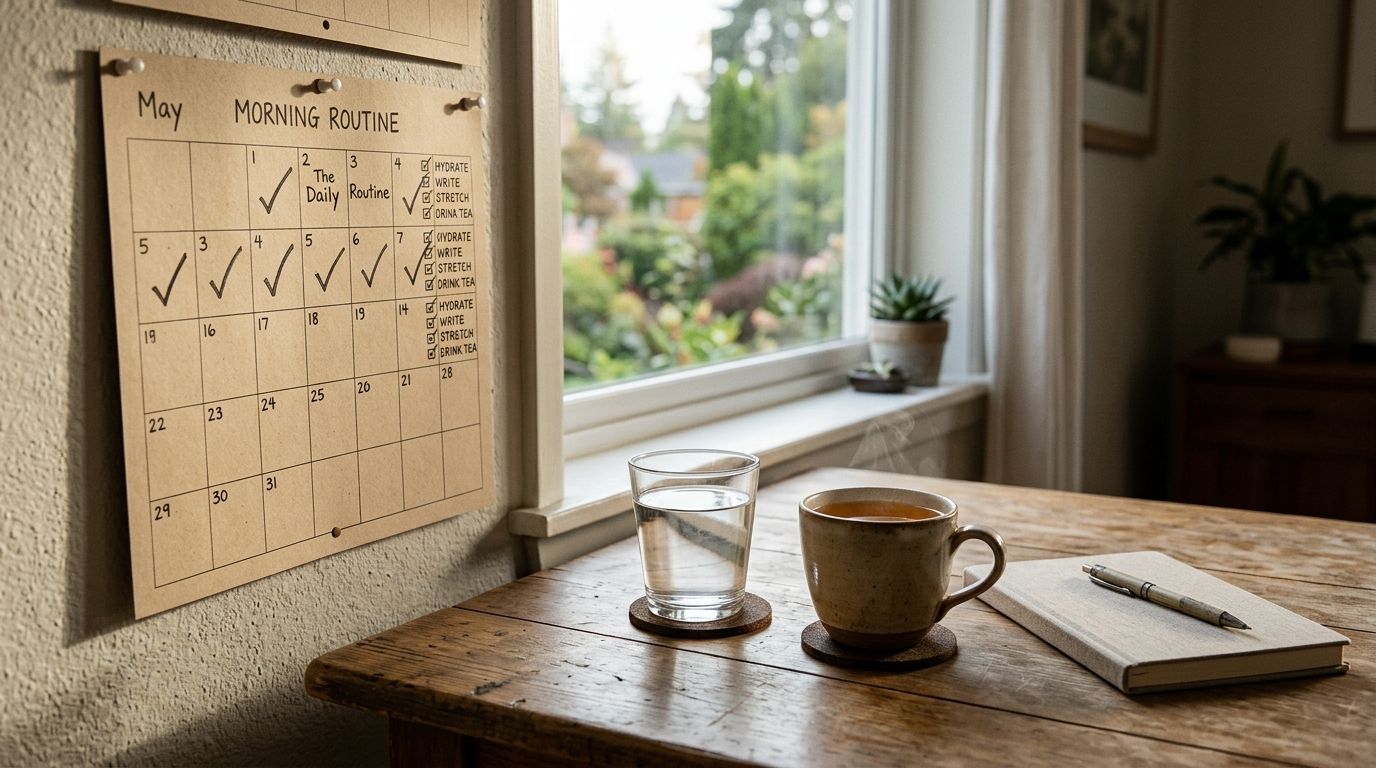
A wall calendar and a pen are perfectly enough. Each day you complete your small habit, you mark an X. After a week, you will have a short chain, and you will feel a gentle reluctance to break it. Do not track ten things at once. Track one habit, perhaps two. The record is not there to judge you, it is there to give you a quiet sense of progress on the days motivation is missing.
When you miss a day, and you will
Nobody keeps a perfect streak. What separates people who succeed over years from those who give up is what they do after a miss. A useful rule is to never miss twice in a row. One missed day is just life. Two in a row is the beginning of a new pattern you probably do not want. So when you slip, do not try to make up for it with a double session or a long apology to yourself. Simply do the smallest possible version the next day, even if it takes one minute, and carry on. This sounds minor, but it removes the guilt that so often ends a good habit.
A routine you can adapt
Here is a gentle example of how a working day could look, as a starting point and not a rule. After waking, drink a glass of water and open the curtains, which signals to your body that the day has started. With your first tea or coffee, write the three priorities for the day. Use your first work block, about ninety minutes, for the hardest task before you check messages. Around midday, take a ten-minute walk without your phone. At the end of the working day, write two lines about what is finished and what comes first tomorrow, which makes it much easier to switch your mind off in the evening. Finally, put screens away about half an hour before bed. None of these steps takes more than a few minutes, and together they create structure without pressure.
Review once a week
Every Sunday, give yourself ten quiet minutes to ask three questions. What worked this week? What kept getting skipped, and why? What is one small change I will make next week? You will often find that the habit you keep skipping is attached to a poor anchor or placed at the wrong time of day, and moving it solves the problem. This weekly check is what turns a rigid plan into a flexible one that grows with you.
What to remember
Choose one anchor, attach one tiny action, protect it for a few weeks, and only then add the next piece. It is not dramatic, and it will not give you a transformation story by Friday. But routines built this way are the ones that are still standing a year later, and a year of small, steady effort changes far more in your life than any single burst of motivation ever could.
This article is for general information and is not professional advice. See our disclaimer.



0 Comments
No comments yet. Be the first to share your thoughts.
Leave a comment
Your email address will not be published. Comments are reviewed before they appear.